
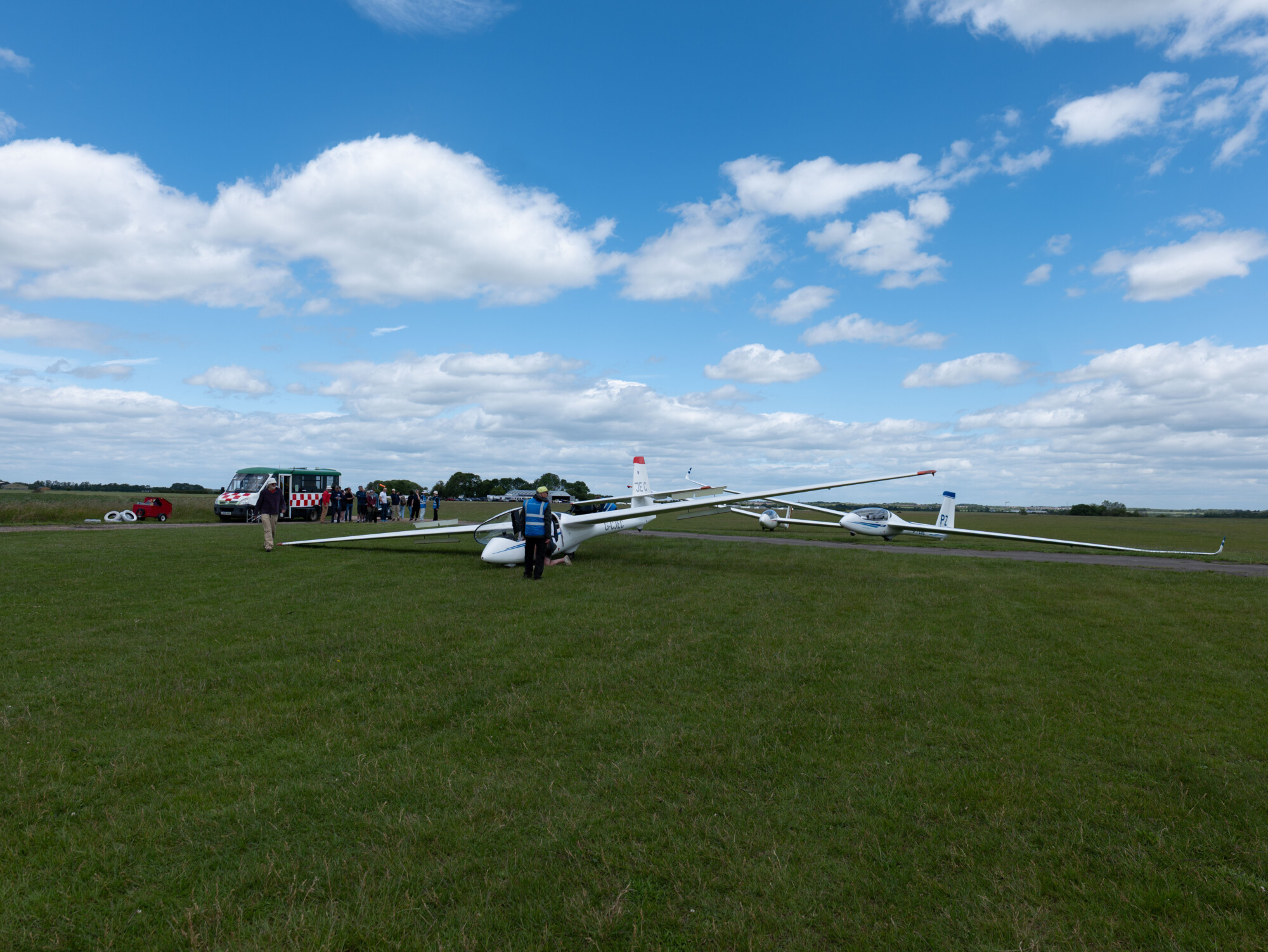
This page describes a typical day at the airfield so that you know how to prepare, and what to expect.
Times and dates
Times
The airfield day is divided into two (sometimes three) sessions: morning, afternoon and (sometimes) evening.
The morning session starts at 08:45. The afternoon starts at 13:30 during British Summer Time, otherwise 12:30. If you are going to be flying during a session, please be at the airfield for the whole session. Volunteers are working to make everything ready but your help is needed: in the morning to get the aircraft out of the hangar and ready for flying, and at the end of the day to wash them put them back in the hangar. Please don’t expect ‘someone else’ to do all that. If you don’t know what to do – please ask; we’ll be happy to show you.
Dates
We operate seven days a week throughout the ‘season’, which is from April through to the end of September. Outside that period we operate at weekends and normally one weekday (more if the weather is particularly good, or if someone organises a special session such as for aerobatics).
Evening flying
Evening flying takes places for specific groups of visitors (for example, local clubs and company groups) who have arranged to come and have a flight. You won’t normally be able to fly during such an event, though you’d be welcome to help.
There is also a regular session of evening flying for members on Tuesdays. It’s a great way to learn to fly because the conditions are generally calmer and you get to fly with the same instructors every week.
How do I get there??
The airfield is a big place which is surprisingly hard to find… There is only one way in. Multiple maps and directions are given here. Once on the airfield, there are many signs for you to read to direct you around the active airfield and to the clubhouse: please follow them. As a general rule: if you are about to drive onto some grass, don’t.
Training
The normal way to train is to book a session with an instructor for a half-day session. It’s not normally beneficial to book for both morning and afternoon sessions on one day; there is a limit to what you can take in and after four or five flights you may feel the need to stop! There are other limits to what you can book depending on whether you are an adult or a member of the University club, for example.
If you book an instruction session, you are expected to turn up. Booking the slot means that someone (a volunteer or professional) is engaged to instruct you, and it means that nobody else can access that training opportunity. For these reasons we may impose penalties for late cancellations and no-shows – terms and conditions are shown on the website when you book.
Details of how to book a training session with an instructor (in a two-seater glider) are given elsewhere.
If you don’t book an instruction session, you can still turn up (or stay late, or come early) and help and there may be an opportunity to fly – but that’s by no means certain. There will definitely be an opportunity to progress your ‘ground’ learning: how (and how not) to move gliders, open canopies, park gliders, launch gliders…
Briefing
One of the instructors who’s on duty at any time is the ‘Team Leader’. The Team Leader in the morning will give a briefing at 09:30 covering:
- Introduce the members of the team (instructors, launch marshal and assistant, tug pilot, winch driver)
- Who’s flying what, and what they want to do
- The weather
- How the airfield will be organised (for example: where the launch point will be and how to get there safely)
- Any special airspace restrictions on the day
- Any particular risks or threats to watch out for (hot weather, low sun, low cloud, gusty wind…)
If you are on the airfield for the morning session, you should present in the clubhouse for the briefing at 09:30.
There may also be a (less formal) briefing at the launch point at the start of the afternoon session.
Inclement weather
Sadly, even Gransden Lodge suffers from this now and again, and we can’t fly. However, as mentioned above, if you book an instruction (two-seater) session, you are expected to turn up regardless. This is because a significant part of your training must be done on the ground in classroom briefing sessions, and because our excellent simulator is available in all weathers and can really help your flying progress rapidly (and cheaply). Given these opportunities your instructors will come to the club prepared to give you the benefit of their time and experience – don’t waste the opportunity.
Food and drink
Tea and coffee are available free of charge in the clubhouse kitchen. Cooking facilities are provided there, as are fridges.
Snacks are available from the office; you must sign for what you take and these amounts will be deducted from your flying account. The available snacks are limited to drinks, crisps, chocolate, pot noodles and soups, ice creams, and some fruit. You may want to bring your own lunch. Hunger and thirst are not conducive to concentration and learning – make sure you stay adequately hydrated and nourished.
